Veeta Conveyors provides robust and efficient Loading Conveyors designed to simplify material loading, reduce manual handling, and improve overall operational productivity. In industries where bulk materials, packaged goods, cartons, bags, boxes, aggregates, and other products need to be transferred quickly and safely, a well-designed loading conveyor can make a significant difference.
Our loading conveyor solutions are engineered with a focus on smooth material movement, dependable operation, convenient handling, workplace efficiency, and long-term performance. By integrating practical conveyor engineering with application-oriented design, Veeta Conveyors helps businesses streamline loading and unloading operations while reducing unnecessary physical effort.
Whether used for warehouse loading, truck loading, dispatch operations, manufacturing plants, packaging facilities, logistics centers, distribution units, or material handling applications, our loading conveyors can be configured according to specific operational requirements.
What Is a Loading Conveyor?
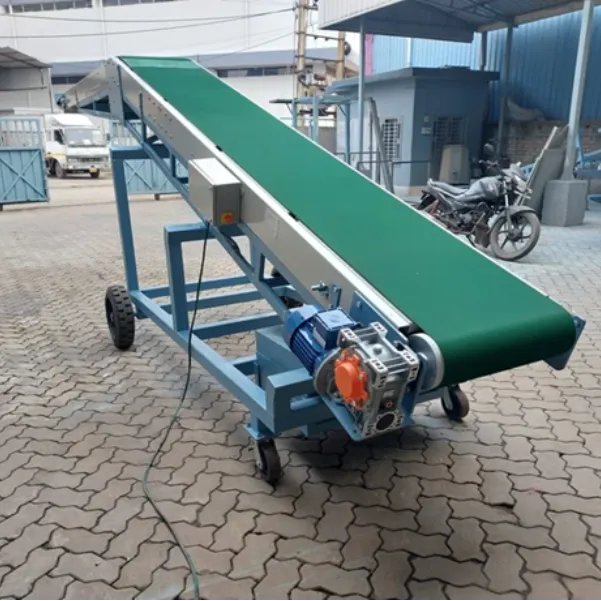
A loading conveyor is a mechanical material-handling system used to transport products or materials from one point to another, particularly during loading and dispatch operations. Instead of relying entirely on manual labor to move goods into trucks, containers, storage areas, or production lines, loading conveyors provide a continuous and organized movement path.
Depending on the application, a loading conveyor can be designed as a fixed, mobile, telescopic, inclined, horizontal, or customized conveyor system.
At Veeta Conveyors, the objective is not simply to manufacture a conveyor but to develop a material handling solution that matches the customer's workflow. Conveyor dimensions, belt configuration, loading capacity, conveying speed, structure, drive arrangement, and other parameters can be selected according to the nature of the material and the operating environment.
Why Choose Loading Conveyors?
Manual material loading can consume considerable time and physical effort, particularly when products need to be moved repeatedly throughout the working day. Loading conveyors introduce a more organized and continuous approach to material movement.
Key advantages include:
Faster loading and unloading operations
Reduced dependence on manual material movement
Improved workplace productivity
Continuous and controlled material flow
Better utilization of manpower
Reduced physical handling of heavy or repetitive loads
Improved dispatch efficiency
Convenient integration with existing material handling systems
Flexible configuration for different applications
Durable construction for demanding industrial environments
A properly selected conveyor can help create a more efficient workflow from production and storage to packaging, dispatch, and transportation.
Loading Conveyors Designed for Industrial Performance
Veeta Conveyors focuses on designing loading conveyors that combine structural strength with practical functionality. Industrial conveyor systems need to operate reliably under repeated loading conditions, and their design must account for factors such as product weight, conveyor length, operating speed, inclination, loading frequency, and workplace conditions.
Our loading conveyors can be developed with suitable components and configurations based on the application. The conveyor structure is designed to provide stability, while the conveying surface is selected according to the material being handled.
The result is a material handling system intended to deliver consistent movement and dependable day-to-day operation.
Applications of Loading Conveyors
Loading conveyors can be used across a wide range of industries and commercial operations.
Warehouse and Distribution
Warehouses frequently need to move cartons, boxes, bags, parcels, and packaged products between storage areas and vehicles. Loading conveyors can simplify this process by creating a continuous path for material movement.
Logistics and Dispatch Centers
In logistics operations, speed and organization are important. Loading conveyors can support repetitive loading activities and help improve the flow of goods between sorting, staging, and transportation areas.
Manufacturing Industries
Manufacturing facilities may use loading conveyors to transfer finished products, components, raw materials, and packaged goods between different workstations or dispatch points.
Packaging Units
After products are packed, they often need to be transferred toward storage or transportation areas. A conveyor can provide an organized route for packaged products and reduce manual movement.
Food and FMCG Industries
Loading conveyors can be configured for handling packaged food products, consumer goods, cartons, containers, and other products where controlled movement is required.
Agricultural and Bulk Material Handling
Depending on the conveyor configuration and belt selection, loading systems can also be used for handling suitable agricultural products and bulk materials.
Construction and Industrial Material Handling
Where applicable, loading conveyors can support the movement of industrial materials and packaged construction products, helping reduce repetitive manual handling.
Features of Veeta Conveyors Loading Conveyors
Veeta Conveyors loading systems can be engineered with application-specific features to support efficient operation.
Strong Conveyor Structure
A robust structural frame helps provide stability during operation and supports the conveyor under regular industrial loading conditions.
Efficient Belt Movement
The conveying system is designed to maintain smooth and controlled belt movement, helping materials travel consistently from the loading point to the discharge area.
Application-Based Conveyor Dimensions
Conveyor length, width, height, and configuration can be selected according to available space, material dimensions, and operational requirements.
Suitable Drive System
The drive arrangement can be selected based on conveying load, speed, operating conditions, and conveyor configuration.
Convenient Material Loading
The loading area can be configured to facilitate easier placement and continuous movement of products.
Flexible Discharge Arrangement
The discharge end can be designed according to the destination of the conveyed material, including trucks, storage areas, production lines, or other handling equipment.
Easy Operational Integration
Loading conveyors can be integrated into broader material handling systems to create a more continuous workflow.
Customized Loading Conveyor Solutions
Every material handling application has different requirements. A conveyor suitable for cartons may not be appropriate for heavy industrial materials, while a warehouse loading conveyor may require a different configuration from a production-line conveyor.
Veeta Conveyors therefore emphasizes application-specific conveyor design.
Customization may include:
Conveyor length
Conveyor width
Conveyor height
Belt type
Belt speed
Conveyor inclination
Loading capacity
Frame configuration
Drive arrangement
Motor selection
Discharge height
Mobility requirements
Safety features
Integration with other equipment
This approach allows customers to select a loading conveyor that fits their operational environment rather than adapting their entire workflow around a standard machine.
Loading Conveyor for Truck Loading
Truck loading is one of the most practical applications of loading conveyors. When goods are manually moved from a warehouse or production area into a vehicle, workers may need to repeatedly lift, carry, and position products.
A loading conveyor can provide a direct material flow toward the vehicle, helping make the loading process more systematic.
Depending on the application, the conveyor can be positioned at a suitable height and angle so that products can move efficiently toward the truck loading area.
This can be particularly useful for operations involving:
Cartons
Bags
Boxes
Packages
Sacks
Consumer products
Industrial components
Finished goods
Improving Workplace Productivity
One of the major objectives of a loading conveyor is to reduce unnecessary manual movement. Instead of assigning multiple workers to repeatedly transport products over short distances, a conveyor can handle continuous product movement.
This can allow workers to focus on tasks such as:
Product arrangement
Quality checking
Packaging
Sorting
Stacking
Inventory handling
Dispatch coordination
By reorganizing the material flow, businesses can potentially achieve better utilization of available manpower and improve overall operational efficiency.
Loading Conveyors and Material Handling Automation
Modern industries are increasingly adopting automation and semi-automation to improve consistency and productivity. Loading conveyors can form an important part of this transition.
A conveyor can be integrated with other equipment and processes such as:
Packaging machines
Sorting systems
Roller conveyors
Belt conveyors
Elevators
Storage systems
Weighing systems
Pallet handling equipment
Dispatch systems
This makes loading conveyors useful not only as individual machines but also as components within a broader industrial material handling system.
Safety-Oriented Conveyor Design
Material handling equipment should be designed with safe operation in mind. Veeta Conveyors can incorporate suitable safety-oriented features according to the conveyor configuration and customer requirements.
These may include appropriate guarding, emergency stopping arrangements, stable structural support, controlled material movement, and suitable operator access.
Safety requirements should always be evaluated according to the specific installation, material being conveyed, workplace environment, and applicable industrial practices.
Durable Construction for Continuous Operations
Industrial loading equipment may be exposed to repetitive loading cycles and demanding working environments. For this reason, durability is an important consideration during conveyor selection.
Veeta Conveyors focuses on practical construction and component selection intended to support reliable operation. Proper maintenance, correct loading practices, suitable operating speeds, and periodic inspection also play an important role in achieving long service life.
Benefits for Businesses
Investing in a suitable loading conveyor can offer several operational benefits:
Reduced Manual Handling: Products can be transported mechanically instead of being carried repeatedly.
Improved Loading Speed: Continuous conveying can help reduce delays during loading and dispatch.
Better Workflow: A defined conveying path creates a more organized movement of materials.
Improved Productivity: Employees can spend more time on productive operational activities.
Flexible Installation: Conveyor dimensions and configuration can be adapted to available space and workflow.
Scalable Material Handling: Conveyor systems can become part of larger material handling and automation solutions.
Why Veeta Conveyors?
Veeta Conveyors aims to provide practical conveyor solutions developed around real-world material handling requirements. Our approach focuses on understanding the application, selecting an appropriate conveyor configuration, and delivering a system designed for dependable operation.
Customers can benefit from:
Application-oriented conveyor design
Customizable specifications
Industrial-grade construction
Practical material handling solutions
Focus on operational efficiency
Flexible conveyor configurations
Support for different industries and applications
The right conveyor is not simply about moving material from Point A to Point B. It is about creating a smooth, efficient, and reliable material flow within the overall operation.
How to Select the Right Loading Conveyor
Before selecting a loading conveyor, businesses should consider several important factors:
Material Type: Determine whether the conveyor will handle cartons, bags, boxes, bulk materials, or other products.
Material Weight: The conveyor must be designed according to the expected load.
Conveyor Length: The required distance between the loading and discharge points affects the conveyor design.
Required Capacity: The expected quantity of material per hour helps determine suitable conveyor specifications.
Conveying Speed: Speed should match the workflow and material characteristics.
Installation Space: Available floor space, height, and access points should be evaluated.
Inclination: If the conveyor needs to move materials vertically or at an angle, the inclination should be selected appropriately.
Operating Environment: Dust, moisture, temperature, cleaning requirements, and other workplace conditions should be considered.
Integration Requirements: If the conveyor will connect with existing machinery, its dimensions and operating characteristics should be compatible.
Maintenance of Loading Conveyors
Regular maintenance helps maintain conveyor performance and can reduce unexpected downtime. Depending on the system, routine maintenance may include:
Checking belt alignment
Inspecting belt condition
Checking rollers and bearings
Inspecting drive components
Checking fasteners and structural joints
Monitoring motor performance
Cleaning accumulated material
Checking safety devices
Lubricating applicable components
Inspecting electrical connections
A planned maintenance schedule based on actual operating conditions can help keep the conveyor system functioning efficiently.
The Future of Smart Material Handling
The future of industrial material handling is moving toward greater automation, data-driven operations, and intelligent equipment integration. Loading conveyors can serve as an important foundation for these developments.
Modern conveyor systems can be designed to work alongside sensors, control systems, automated machinery, and digital monitoring technologies. As businesses look for better productivity and reduced operational bottlenecks, intelligent conveyor-based material handling solutions can become increasingly valuable.
Veeta Conveyors continues to focus on practical conveyor engineering while keeping the evolving requirements of modern industries in view.
Choose Veeta Conveyors for Loading Conveyor Solutions
A dependable loading conveyor can transform repetitive material movement into a more organized and efficient process. From warehouse dispatch and truck loading to manufacturing, packaging, logistics, and industrial material handling, the right conveyor configuration can help businesses improve productivity and simplify daily operations.
Veeta Conveyors provides loading conveyor solutions designed around application requirements, operational efficiency, durability, and practical material handling needs.
If you are looking for a Loading Conveyor Manufacturer, Supplier, or Customized Loading Conveyor Solution, Veeta Conveyors can help you identify a suitable configuration based on your material, capacity, space, loading requirements, and workflow.
Get the Right Loading Conveyor for Your Application
Contact Veeta Conveyors to discuss your material handling requirements and explore a suitable loading conveyor configuration for your facility.
Veeta Conveyors – Moving Materials. Improving Efficiency. Supporting Modern Industry.
Our loading conveyor solutions are engineered with a focus on smooth material movement, dependable operation, convenient handling, workplace efficiency, and long-term performance. By integrating practical conveyor engineering with application-oriented design, Veeta Conveyors helps businesses streamline loading and unloading operations while reducing unnecessary physical effort.
Whether used for warehouse loading, truck loading, dispatch operations, manufacturing plants, packaging facilities, logistics centers, distribution units, or material handling applications, our loading conveyors can be configured according to specific operational requirements.
What Is a Loading Conveyor?
A loading conveyor is a mechanical material-handling system used to transport products or materials from one point to another, particularly during loading and dispatch operations. Instead of relying entirely on manual labor to move goods into trucks, containers, storage areas, or production lines, loading conveyors provide a continuous and organized movement path.
Depending on the application, a loading conveyor can be designed as a fixed, mobile, telescopic, inclined, horizontal, or customized conveyor system.
At Veeta Conveyors, the objective is not simply to manufacture a conveyor but to develop a material handling solution that matches the customer's workflow. Conveyor dimensions, belt configuration, loading capacity, conveying speed, structure, drive arrangement, and other parameters can be selected according to the nature of the material and the operating environment.
Why Choose Loading Conveyors?
Manual material loading can consume considerable time and physical effort, particularly when products need to be moved repeatedly throughout the working day. Loading conveyors introduce a more organized and continuous approach to material movement.
Key advantages include:
Faster loading and unloading operations
Reduced dependence on manual material movement
Improved workplace productivity
Continuous and controlled material flow
Better utilization of manpower
Reduced physical handling of heavy or repetitive loads
Improved dispatch efficiency
Convenient integration with existing material handling systems
Flexible configuration for different applications
Durable construction for demanding industrial environments
A properly selected conveyor can help create a more efficient workflow from production and storage to packaging, dispatch, and transportation.
Loading Conveyors Designed for Industrial Performance
Veeta Conveyors focuses on designing loading conveyors that combine structural strength with practical functionality. Industrial conveyor systems need to operate reliably under repeated loading conditions, and their design must account for factors such as product weight, conveyor length, operating speed, inclination, loading frequency, and workplace conditions.
Our loading conveyors can be developed with suitable components and configurations based on the application. The conveyor structure is designed to provide stability, while the conveying surface is selected according to the material being handled.
The result is a material handling system intended to deliver consistent movement and dependable day-to-day operation.
Applications of Loading Conveyors
Loading conveyors can be used across a wide range of industries and commercial operations.
Warehouse and Distribution
Warehouses frequently need to move cartons, boxes, bags, parcels, and packaged products between storage areas and vehicles. Loading conveyors can simplify this process by creating a continuous path for material movement.
Logistics and Dispatch Centers
In logistics operations, speed and organization are important. Loading conveyors can support repetitive loading activities and help improve the flow of goods between sorting, staging, and transportation areas.
Manufacturing Industries
Manufacturing facilities may use loading conveyors to transfer finished products, components, raw materials, and packaged goods between different workstations or dispatch points.
Packaging Units
After products are packed, they often need to be transferred toward storage or transportation areas. A conveyor can provide an organized route for packaged products and reduce manual movement.
Food and FMCG Industries
Loading conveyors can be configured for handling packaged food products, consumer goods, cartons, containers, and other products where controlled movement is required.
Agricultural and Bulk Material Handling
Depending on the conveyor configuration and belt selection, loading systems can also be used for handling suitable agricultural products and bulk materials.
Construction and Industrial Material Handling
Where applicable, loading conveyors can support the movement of industrial materials and packaged construction products, helping reduce repetitive manual handling.
Features of Veeta Conveyors Loading Conveyors
Veeta Conveyors loading systems can be engineered with application-specific features to support efficient operation.
Strong Conveyor Structure
A robust structural frame helps provide stability during operation and supports the conveyor under regular industrial loading conditions.
Efficient Belt Movement
The conveying system is designed to maintain smooth and controlled belt movement, helping materials travel consistently from the loading point to the discharge area.
Application-Based Conveyor Dimensions
Conveyor length, width, height, and configuration can be selected according to available space, material dimensions, and operational requirements.
Suitable Drive System
The drive arrangement can be selected based on conveying load, speed, operating conditions, and conveyor configuration.
Convenient Material Loading
The loading area can be configured to facilitate easier placement and continuous movement of products.
Flexible Discharge Arrangement
The discharge end can be designed according to the destination of the conveyed material, including trucks, storage areas, production lines, or other handling equipment.
Easy Operational Integration
Loading conveyors can be integrated into broader material handling systems to create a more continuous workflow.
Customized Loading Conveyor Solutions
Every material handling application has different requirements. A conveyor suitable for cartons may not be appropriate for heavy industrial materials, while a warehouse loading conveyor may require a different configuration from a production-line conveyor.
Veeta Conveyors therefore emphasizes application-specific conveyor design.
Customization may include:
Conveyor length
Conveyor width
Conveyor height
Belt type
Belt speed
Conveyor inclination
Loading capacity
Frame configuration
Drive arrangement
Motor selection
Discharge height
Mobility requirements
Safety features
Integration with other equipment
This approach allows customers to select a loading conveyor that fits their operational environment rather than adapting their entire workflow around a standard machine.
Loading Conveyor for Truck Loading
Truck loading is one of the most practical applications of loading conveyors. When goods are manually moved from a warehouse or production area into a vehicle, workers may need to repeatedly lift, carry, and position products.
A loading conveyor can provide a direct material flow toward the vehicle, helping make the loading process more systematic.
Depending on the application, the conveyor can be positioned at a suitable height and angle so that products can move efficiently toward the truck loading area.
This can be particularly useful for operations involving:
Cartons
Bags
Boxes
Packages
Sacks
Consumer products
Industrial components
Finished goods
Improving Workplace Productivity
One of the major objectives of a loading conveyor is to reduce unnecessary manual movement. Instead of assigning multiple workers to repeatedly transport products over short distances, a conveyor can handle continuous product movement.
This can allow workers to focus on tasks such as:
Product arrangement
Quality checking
Packaging
Sorting
Stacking
Inventory handling
Dispatch coordination
By reorganizing the material flow, businesses can potentially achieve better utilization of available manpower and improve overall operational efficiency.
Loading Conveyors and Material Handling Automation
Modern industries are increasingly adopting automation and semi-automation to improve consistency and productivity. Loading conveyors can form an important part of this transition.
A conveyor can be integrated with other equipment and processes such as:
Packaging machines
Sorting systems
Roller conveyors
Belt conveyors
Elevators
Storage systems
Weighing systems
Pallet handling equipment
Dispatch systems
This makes loading conveyors useful not only as individual machines but also as components within a broader industrial material handling system.
Safety-Oriented Conveyor Design
Material handling equipment should be designed with safe operation in mind. Veeta Conveyors can incorporate suitable safety-oriented features according to the conveyor configuration and customer requirements.
These may include appropriate guarding, emergency stopping arrangements, stable structural support, controlled material movement, and suitable operator access.
Safety requirements should always be evaluated according to the specific installation, material being conveyed, workplace environment, and applicable industrial practices.
Durable Construction for Continuous Operations
Industrial loading equipment may be exposed to repetitive loading cycles and demanding working environments. For this reason, durability is an important consideration during conveyor selection.
Veeta Conveyors focuses on practical construction and component selection intended to support reliable operation. Proper maintenance, correct loading practices, suitable operating speeds, and periodic inspection also play an important role in achieving long service life.
Benefits for Businesses
Investing in a suitable loading conveyor can offer several operational benefits:
Reduced Manual Handling: Products can be transported mechanically instead of being carried repeatedly.
Improved Loading Speed: Continuous conveying can help reduce delays during loading and dispatch.
Better Workflow: A defined conveying path creates a more organized movement of materials.
Improved Productivity: Employees can spend more time on productive operational activities.
Flexible Installation: Conveyor dimensions and configuration can be adapted to available space and workflow.
Scalable Material Handling: Conveyor systems can become part of larger material handling and automation solutions.
Why Veeta Conveyors?
Veeta Conveyors aims to provide practical conveyor solutions developed around real-world material handling requirements. Our approach focuses on understanding the application, selecting an appropriate conveyor configuration, and delivering a system designed for dependable operation.
Customers can benefit from:
Application-oriented conveyor design
Customizable specifications
Industrial-grade construction
Practical material handling solutions
Focus on operational efficiency
Flexible conveyor configurations
Support for different industries and applications
The right conveyor is not simply about moving material from Point A to Point B. It is about creating a smooth, efficient, and reliable material flow within the overall operation.
How to Select the Right Loading Conveyor
Before selecting a loading conveyor, businesses should consider several important factors:
Material Type: Determine whether the conveyor will handle cartons, bags, boxes, bulk materials, or other products.
Material Weight: The conveyor must be designed according to the expected load.
Conveyor Length: The required distance between the loading and discharge points affects the conveyor design.
Required Capacity: The expected quantity of material per hour helps determine suitable conveyor specifications.
Conveying Speed: Speed should match the workflow and material characteristics.
Installation Space: Available floor space, height, and access points should be evaluated.
Inclination: If the conveyor needs to move materials vertically or at an angle, the inclination should be selected appropriately.
Operating Environment: Dust, moisture, temperature, cleaning requirements, and other workplace conditions should be considered.
Integration Requirements: If the conveyor will connect with existing machinery, its dimensions and operating characteristics should be compatible.
Maintenance of Loading Conveyors
Regular maintenance helps maintain conveyor performance and can reduce unexpected downtime. Depending on the system, routine maintenance may include:
Checking belt alignment
Inspecting belt condition
Checking rollers and bearings
Inspecting drive components
Checking fasteners and structural joints
Monitoring motor performance
Cleaning accumulated material
Checking safety devices
Lubricating applicable components
Inspecting electrical connections
A planned maintenance schedule based on actual operating conditions can help keep the conveyor system functioning efficiently.
The Future of Smart Material Handling
The future of industrial material handling is moving toward greater automation, data-driven operations, and intelligent equipment integration. Loading conveyors can serve as an important foundation for these developments.
Modern conveyor systems can be designed to work alongside sensors, control systems, automated machinery, and digital monitoring technologies. As businesses look for better productivity and reduced operational bottlenecks, intelligent conveyor-based material handling solutions can become increasingly valuable.
Veeta Conveyors continues to focus on practical conveyor engineering while keeping the evolving requirements of modern industries in view.
Choose Veeta Conveyors for Loading Conveyor Solutions
A dependable loading conveyor can transform repetitive material movement into a more organized and efficient process. From warehouse dispatch and truck loading to manufacturing, packaging, logistics, and industrial material handling, the right conveyor configuration can help businesses improve productivity and simplify daily operations.
Veeta Conveyors provides loading conveyor solutions designed around application requirements, operational efficiency, durability, and practical material handling needs.
If you are looking for a Loading Conveyor Manufacturer, Supplier, or Customized Loading Conveyor Solution, Veeta Conveyors can help you identify a suitable configuration based on your material, capacity, space, loading requirements, and workflow.
Get the Right Loading Conveyor for Your Application
Contact Veeta Conveyors to discuss your material handling requirements and explore a suitable loading conveyor configuration for your facility.
Veeta Conveyors – Moving Materials. Improving Efficiency. Supporting Modern Industry.
Keywords